


.svg)







Proyek Kami
Di Ecoxplore, kami bangga mempertahankan standar kualitas dan keunggulan tertinggi. Komitmen kami terhadap praktik-praktik terdepan di industri tercermin dalam rangkaian sertifikasi kami yang komprehensif

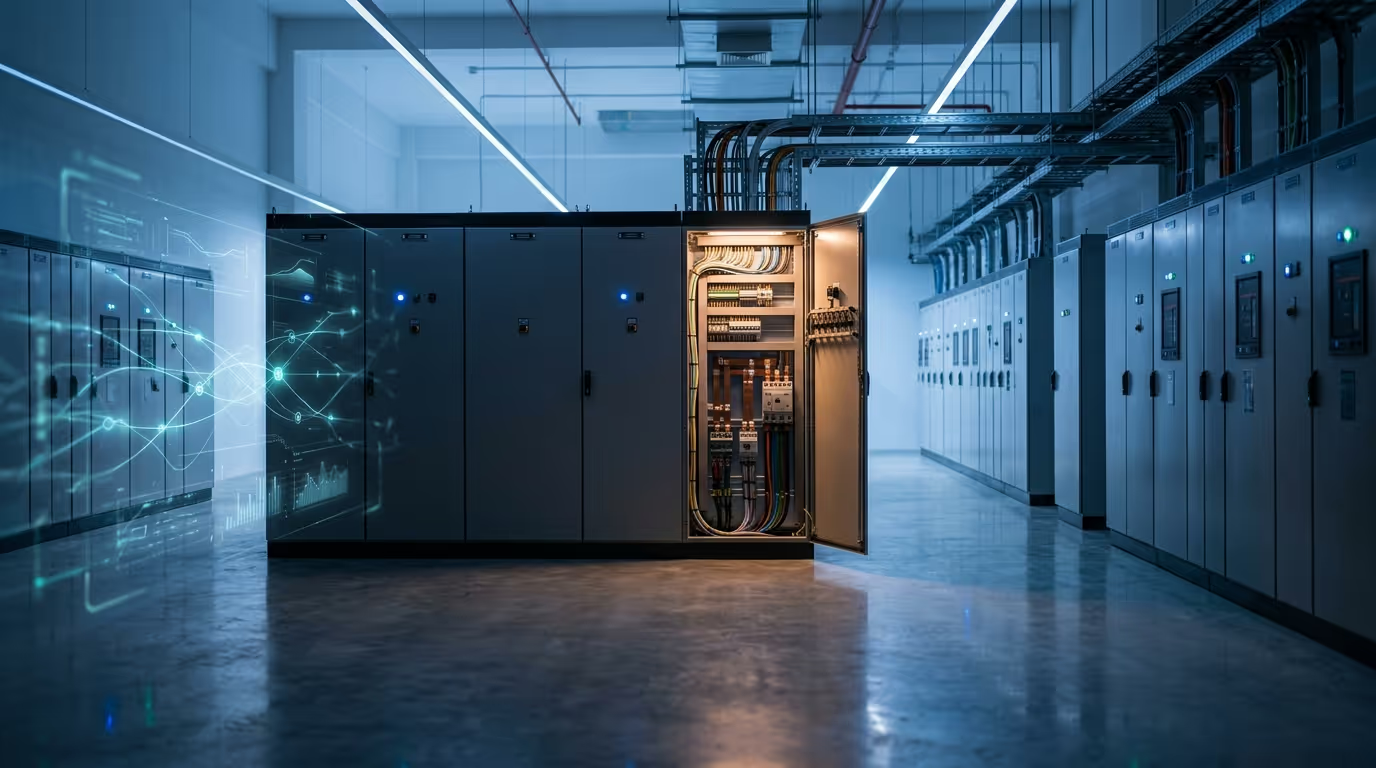
Client snapshot
Client: SingTel Group Enterprise (DC West data centre) Site: Hall 11, DC West, Singapore Sector: Telecommunications / colocation data centre Project window: Confirm with engineering — multi-phase across Hall 11 commissioning EcoXplore scope: EMRS (Energy Management and Reporting System) and DCIM integration
Why the project mattered
DC West is one of the largest data centres in Singapore by capacity. Hall 11 was commissioned with an integrated EMRS / DCIM stack rather than the more common practice of bolting reporting on after commissioning. The integration matters because PUE (Power Usage Effectiveness) is the metric every Tier III/IV data centre is judged on, and PUE that cannot be defended at meter level cannot be defended in front of an enterprise customer's procurement team.
Engagement scope
- Real-time energy monitoring at IT-load, mechanical-cooling, UPS, lighting, and auxiliary-system feeders.
- DCIM integration so meter data, breaker status, temperature, and humidity surface in a single operator pane rather than across vendor-specific consoles.
- PUE calculation engine with rolling 1-minute, hourly, daily, weekly, and annual aggregations against the IT load denominator.
- Alarm hierarchy so a temperature excursion or a UPS bypass event surfaces to the operations team before it propagates to the customer-facing console.
- Reporting templates matching SingTel's enterprise customer reporting cadence.
Hardware and integration boundary
The Hall 11 stack uses Class A revenue-grade meters at the main intakes and UPS input/output points, with Class 1 submeters at branch circuits where the resolution was sufficient. The meters feed an on-premise historian, and the DCIM platform pulls from the historian rather than scanning meters directly. This separation means the DCIM upgrade path is decoupled from the meter refresh cycle — the operations team can change either layer without re-commissioning the other.
Communication protocols at the field layer are Modbus TCP for the meters and BACnet/IP for the cooling-system controls. OPC UA bridges the field layer to the DCIM platform.
Outcome
The Hall 11 deployment achieved live PUE visibility at hall-level granularity from day one of customer onboarding, with the reporting templates matching SingTel's enterprise customer requirements without manual reconciliation. SME to add: specific PUE figure or improvement, alarm-volume metric, or commissioning-time saved relative to a parallel-stack baseline.
Why it works
Three design choices that the operations team has continued to validate:
- Single historian, multiple consumers. The DCIM, the customer-facing dashboards, and the operations team's own KPI views all pull from the same historian. No reconciliation between systems.
- Class A meters at the IT denominator. PUE numerator and denominator both measured to Class A. The number stands up to enterprise customer audits.
- Open protocols throughout. Modbus TCP / BACnet/IP / OPC UA at the integration boundaries means the next refresh is not locked to a single vendor.
Project lead
Engineering lead (EcoXplore): SME to add named engineer with DCIM credentials. Operations lead (SingTel): Position only or named with explicit permission.
Related EcoXplore solutions
- Energy Management System (EMS)
- Building Management System (BMS)
- Power Quality Monitoring System (PQMS)
For a similar deployment, contact the EcoXplore team.

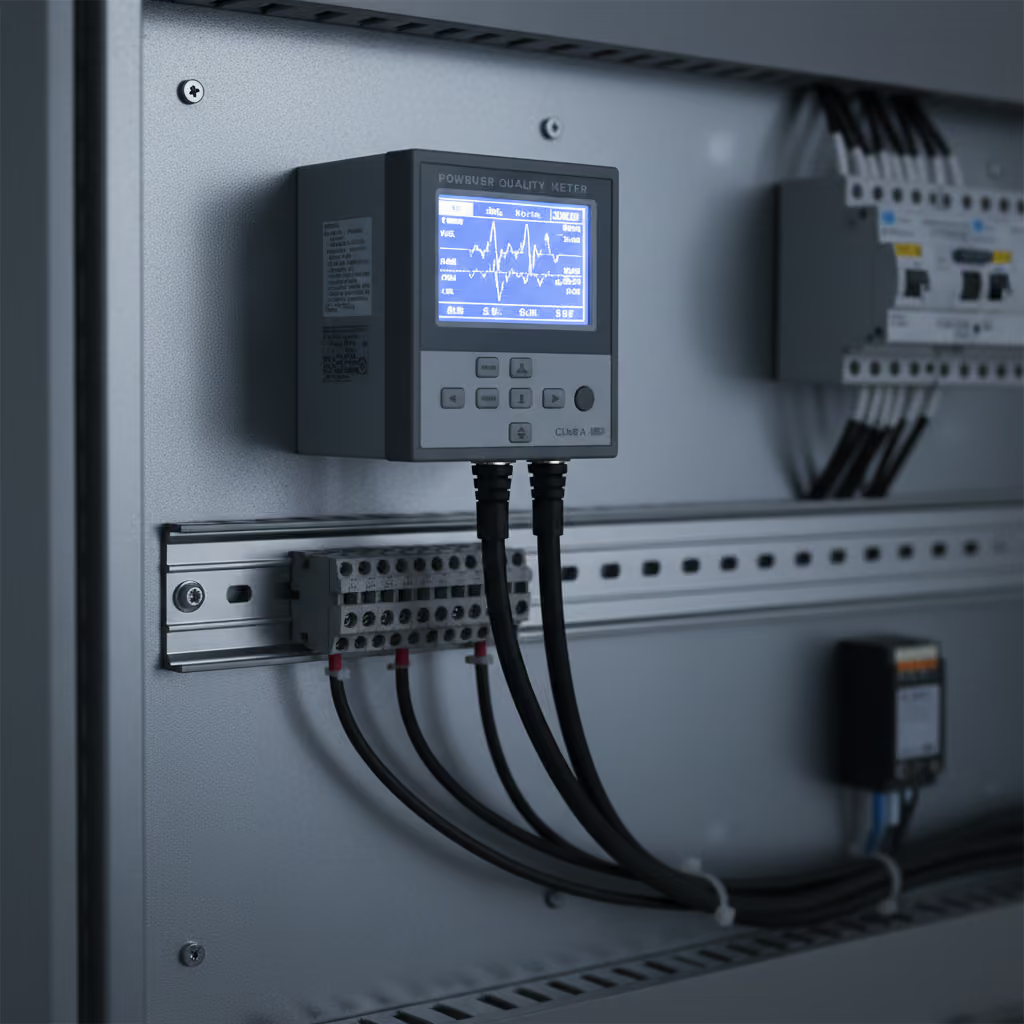
Client snapshot
Client: Mediacorp Pte Ltd Site: Mediacorp campus, Singapore Sector: Broadcasting and media Project window: Multi-phase deployment — confirm with project engineering. EcoXplore scope: PMCS (Power Monitoring and Control System) using PecStar® iEMS, panel-meter rollout and historian integration.
Why the project mattered
A broadcaster's campus runs around the clock. Studio control rooms, transmission facilities, server rooms, and broadcast technology suites cannot ride through extended outages, and the cost of unexplained energy spikes lands directly on the operations budget. A PMCS that can attribute consumption to individual panels, circuits, and studios is the precondition for managing both efficiency and reliability.
Engagement scope
The Mediacorp PMCS deployment is among the largest panel-level monitoring rollouts EcoXplore has delivered in Singapore. Headline numbers (per references/blog-article.md):
- 1,000+ panel meters distributed across the campus
- 130 data loggers aggregating panel readings before forwarding to the historian
- 30 servers running the historian, dashboards, and analytics tier
The choice of PecStar® iEMS as the historian and operations platform reflects the scale: the system has been engineered to handle the tag explosion that comes with thousand-point sites without the per-tag licensing penalties common in older SCADA stacks.
Hardware and integration boundary
Panel meters were chosen for their cost-to-accuracy ratio at the branch-circuit level (Class 1) rather than Class 0.5S, because the revenue-grade boundary is a smaller set of meters at the campus intakes. Data loggers aggregate Modbus RTU panel-meter traffic onto Modbus TCP for upstream consumption by the historian — keeping the field-side cabling cost down while preserving end-to-end traceability.
The 30-server historian tier is sized for both live operations and the reporting workload that comes with sustainability disclosure obligations.
Operational outcomes
Outcomes the Mediacorp operations team has reported (SME to confirm which are quotable):
- Campus-wide consumption visibility down to individual panel level, replacing prior spreadsheet-based reconciliation.
- Studio-level attribution for energy chargebacks and operations budgeting.
- Single source of truth for sustainability reporting on Scope 2 emissions.
- Operator alarms when panel consumption deviates from learned baselines, allowing pre-emptive maintenance on overloaded or failing equipment.
SME to add: a specific quantified outcome — energy intensity reduction, audit-time saved, or asset-failure prediction lead-time.
Why it works at this scale
Three design choices that the campus operations team has continued to validate:
- Branch-level meters, panel-level granularity. Granularity at the panel meter, not at every branch circuit. Cheaper than fully circuit-level monitoring, more useful than building-level only.
- Hierarchical aggregation. 1,000+ panel meters do not all talk to the historian directly. 130 data loggers do the aggregation, which keeps the network architecture sane and the historian write rate manageable.
- Platform sized for the data. 30 servers means the historian, dashboards, and analytics can run concurrently without the analytics jobs starving the live operator views. This is a common failure mode in under-sized PMCS deployments.
Project lead
Engineering lead (EcoXplore): SME to add named PMCS lead. Operations lead (Mediacorp): Position only, or named with explicit permission.
Related EcoXplore solutions
For a similar campus-scale deployment, contact the EcoXplore team.

Client snapshot
Client: GlobalFoundries (Singapore operations) Site: GlobalFoundries fab, Singapore Sector: Semiconductor manufacturing Project window: Confirm with engineering — PQMS rollout multi-phase EcoXplore scope: Power Quality Monitoring System at critical fab feeders; Class A meter deployment per IEC 61000-4-30
Why the project mattered
A single voltage sag at a semiconductor fab can scrap a wafer batch. The losses are large enough that a fab will spend significant capex to make the next sag visible — not because the sag is preventable from the customer side, but because the forensic record proves who caused it, what survived, and what mitigations to specify next.
GlobalFoundries' fab in Singapore deployed PQMS to capture exactly that record at the tie-ins between utility supply and process-critical loads.
Engagement scope
EcoXplore's PQMS scope at GlobalFoundries covered:
- Class A meters per IEC 61000-4-30 at the critical busbars feeding lithography, etch, and chemical-mechanical planarisation loads.
- Event capture at sub-cycle resolution for transient and sag analysis.
- Harmonic compliance reporting against IEEE 519-2022 for the utility tie-in study.
- Integration with the fab's existing operations historian so PQ events correlate with process-equipment events in time.
- Operator alarms for events that exceed the equipment ride-through envelopes (ITIC / CBEMA references).
Hardware and integration boundary
The meter selection at the critical busbars matches the highest standard available — Class A per IEC 61000-4-30 Edition 3, with the conformance test report from the manufacturer reviewed before purchase order. Less critical feeders use Class 0.5S meters that serve double duty as revenue-grade energy meters.
The integration boundary sits at the fab historian. PQMS events are pushed at write time and tagged with the same plant-equipment hierarchy the process team uses, so correlation between a 100-ms sag and a stepper trip can be reconstructed without joining tools.
Operational outcomes
Outcomes the GlobalFoundries operations team has confirmed (SME to confirm which are quotable):
- Forensic event records support utility correspondence when PQ events originate upstream of the customer boundary.
- Equipment ride-through specifications can be tightened against measured site conditions rather than vendor brochure data.
- Process incident reviews include power quality data as a first-class input rather than an afterthought.
SME to add: a specific quantified outcome — number of PQ events captured per quarter, estimated downtime cost avoided, or IEEE 519 compliance milestone.
Why it works in this environment
Three design choices that the fab operations team has continued to validate:
- Class A or do not bother. Cheaper PQ meters cannot defensibly report on sags or transients. Fab budget for PQMS supports the right instruments because the alternative is gambling on whether a recorded event will hold up under utility dispute.
- Forensic granularity, not summary granularity. Sub-cycle event capture. Summary statistics over 15-minute intervals will miss the events that matter.
- Single historian. PQ events live in the same historian as process events. Forensic correlation does not require a forensics specialist to assemble.
Project lead
Engineering lead (EcoXplore): SME to add named PQMS lead with semiconductor experience. Operations lead (GlobalFoundries): Position only — semiconductor sites typically prefer not to name individual facilities engineers.
Related EcoXplore solutions
- Power Quality Monitoring System (PQMS)
- Energy Management System (EMS)
- EMS vs PQMS — when you need both
For a similar fab-scale PQMS deployment, contact the EcoXplore team.

Why the project mattered
Judicial buildings have a narrow operational envelope: court schedules cannot tolerate environmental excursions, security and access controls cannot fail, and operating costs are publicly reported. Building monitoring at this class of site has to be reliable, auditable, and integrated with the operations team's existing workflow rather than replacing it.
Engagement scope
- HVAC monitoring and control at courtroom, chamber, and public-area level with separate setpoint regimes per zone class.
- Sub-metering for energy attribution by area type so operating cost can be reported against zone occupancy.
- Operator dashboards designed against the facilities team's existing workflow, including the alarm hierarchy and reporting templates already in use.
- Documented commissioning with point-by-point test records and sequence-of-operation tests against the design intent.
Hardware and integration boundary
The deployment uses Class 1 sub-meters at zone boundaries and BACnet/IP at the supervisory layer, with field protocols (Modbus, LonWorks where existing equipment requires it) bridged at the controller. The historian is on-premise; reporting is built against the historian rather than the BMS itself so the operations team can refresh either layer without re-commissioning the other.
Operational outcomes
- Continuous environmental compliance across courtroom and chamber zones during operating hours, with audit-quality timestamped records.
- Sub-metered energy attribution feeding the building's annual energy reporting against BCA Green Mark and government sustainability targets.
- Alarm volume kept within an operator-manageable band through threshold tuning and alarm classification.
Why it works
Three design principles that apply to any government building monitoring deployment:
- Open protocols, no vendor lock-in. Government buildings outlive the contractors that deploy in them. Open protocols at the integration boundary protect the asset.
- Operator-led design. The facilities team is the long-term operator. The dashboards, alarms, and reporting templates are designed against their workflow, not the integrator's defaults.
- Documented commissioning. Point-by-point test records, sequence-of-operation tests against the design intent, and training delivered to the on-site team.
Related EcoXplore solutions
For a similar government building deployment, contact the EcoXplore team.

Why the project mattered
Integrated resorts run on a different operations rhythm to most buildings. Peak occupancy and peak power coincide; food and beverage, hotel, attractions, and back-of-house loads each have their own profiles, and the sustainability disclosure obligations of resort operators are increasingly tied to measured rather than estimated consumption.
A monitoring system that can attribute energy by zone, by tenant, and by event window is the precondition for both efficiency and ESG-grade reporting.
Engagement scope
- Energy management across resort zones, with sub-metering granular enough to attribute consumption to hotel, F&B, attractions, and back-of-house.
- BMS integration for HVAC, lighting, and access control across zones.
- Reporting templates matching the operator's ESG disclosure cadence and internal sustainability targets.
- Operator dashboards for the central facilities team and zone-level supervisors, each tuned to the operational decisions made at that level.
Hardware and integration boundary
The deployment uses Class 0.5S meters at revenue boundaries and Class 1 at downstream sub-meters. BACnet/IP is the supervisory protocol; Modbus carries meter and VFD data at the field layer. An on-premise historian feeds both the operations dashboards and the ESG reporting pipeline, so reporting is decoupled from real-time control.
Operational outcomes
- Zone-attributed energy reporting feeding the parent operator's ESG disclosure cycle without manual reconciliation.
- Peak demand visibility at zone level, enabling staged load-shedding during event windows.
- Sub-metered consumption data supporting BCA Green Mark submissions and internal sustainability targets.
Why it works in a resort environment
Three design principles that apply across integrated-resort monitoring:
- Zone-level attribution. Resort F&B, hotel, attractions, and gaming have different load profiles and different operations teams. Bulk metering hides accountability; zone-level metering surfaces it.
- Operations rhythm awareness. Reporting and alarm thresholds tuned to event windows (busy weekends, major shows) rather than fixed daily baselines.
- Open protocols for tenant integration. Where third-party operators (restaurants, retail concessions) need their own consumption data, open protocols let them pull their slice without compromising central operations.
Related EcoXplore solutions
- Energy Management System (EMS)
- Building Management System (BMS)
- HVAC Monitoring System
- Lighting Control Management System
For a similar integrated-resort or hospitality deployment, contact the EcoXplore team.

Challenge
A commercial retail building operates 24/7 with multiple tenant spaces requiring independent climate control. The challenge: optimize energy efficiency while ensuring consistent comfort for tenants and customers across diverse building zones.
Solution
EcoXplore deployed an integrated building management and energy monitoring system with:
- Smart metering for common areas and sub-metering for tenant spaces
- Centralised HVAC control with zone-based scheduling responsive to occupancy
- Automated lighting control based on occupancy sensors and daylight harvesting
- Predictive maintenance for cooling and heating systems
Results
- Reduced common area energy consumption by 19% through automated controls
- Improved tenant satisfaction through responsive environmental controls
- Prevented 3 HVAC failures through predictive maintenance
- Achieved payback on monitoring system investment in 18 months

Challenge
A medical device manufacturing facility must comply with FDA GMP regulations and maintain strict environmental controls for product quality. The challenge: ensure regulatory compliance, maintain consistent environmental conditions, and optimize energy efficiency.
Solution
EcoXplore deployed an integrated environmental monitoring and quality management system with:
- Continuous monitoring of environmental conditions in manufacturing and quality control areas
- Automated logging of all environmental data for regulatory compliance and audit trails
- Predictive maintenance for HVAC and environmental control systems
- Real-time alerts for any out-of-specification conditions
Results
- Achieved 100% FDA GMP compliance with zero environmental excursions
- Reduced environmental control system energy consumption by 15%
- Improved product quality and reduced defect rates through maintained environmental consistency
- Simplified regulatory audits through automated data logging and reporting

Challenge
A data centre facility houses 500+ server racks with critical IT infrastructure supporting business-critical applications. The challenge: maintain precise cooling to prevent equipment overheating while optimizing power consumption and cooling energy in a 24/7 operation.
Solution
EcoXplore deployed an advanced data centre infrastructure management (DCIM) solution with:
- Real-time monitoring of server inlet temperatures, PDU power delivery, and cooling system status
- Rack-level power and cooling density visualization to identify hot spots
- Predictive alerting for equipment approaching thermal or electrical limits
- Automated cooling optimization through dynamic aisle containment and setpoint management
Results
- Reduced cooling energy consumption by 22% through optimized airflow and setpoint management
- Prevented 4 server failures due to overheating through early thermal alerts
- Improved PUE (Power Usage Effectiveness) from 2.3 to 1.8
- Enabled 20% increase in server density without additional cooling capacity

Challenge
A microelectronics assembly facility requires clean room conditions with strict temperature, humidity, and particulate control. The challenge: maintain clean room specifications 24/7 while managing high energy costs associated with clean room operations.
Solution
EcoXplore deployed a clean room monitoring and optimization system with:
- Continuous monitoring of clean room environmental conditions including temperature, humidity, and particulate levels
- Automated alerts for any deviation from clean room specifications
- Predictive maintenance for HVAC and filtration systems
- Energy optimization through intelligent scheduling of air handling units and filtration stages
Results
- Maintained 99.95% compliance with clean room specifications
- Reduced HVAC and filtration energy consumption by 18% without compromising clean room quality
- Prevented 2 critical HVAC failures that would have stopped production
- Improved product yields through maintained environmental consistency

Challenge
A hospital with 500+ beds, surgical suites, emergency departments, and intensive care units requires integrated facilities management. The challenge: maintain critical system uptime for patient safety while optimizing operational costs and ensuring comfort for patients and staff.
Solution
EcoXplore deployed a comprehensive building management and energy monitoring solution with:
- Continuous monitoring of HVAC, electrical, and emergency systems across all buildings
- Automated responses to equipment anomalies and alarms
- Predictive maintenance for critical systems including backup generators, UPS systems, and chillers
- Real-time energy monitoring to identify consumption anomalies and inefficiencies
Results
- Achieved 99.98% uptime for critical systems essential to patient care
- Reduced energy costs by 16% through optimized building operations
- Prevented 6 critical equipment failures through predictive monitoring
- Improved staff efficiency through responsive environmental controls
.avif)
Challenge
A food manufacturing facility must maintain strict temperature and humidity control for product safety and regulatory compliance. The challenge: maintain consistent environmental conditions while optimizing energy costs in a 24/7 manufacturing operation.
Solution
EcoXplore deployed an integrated environmental monitoring and energy optimization system with:
- Continuous temperature and humidity monitoring across all production and storage areas
- Automated HVAC controls to maintain setpoints while minimizing energy use
- Predictive maintenance for refrigeration and environmental control systems
- Historical data trending to identify inefficiencies and opportunities for optimization
Results
- Maintained 99.8% compliance with strict environmental specifications
- Reduced HVAC energy consumption by 14% through optimized controls
- Prevented 3 refrigeration system failures through predictive monitoring
- Achieved product quality improvements through maintained environmental consistency

Challenge
A major pharmaceutical manufacturing facility must comply with strict FDA regulations for temperature and humidity control in production areas, while managing high energy costs in a competitive industry. The challenge: maintain regulatory compliance, minimize energy consumption, and ensure product quality.
Solution
EcoXplore deployed an integrated environmental monitoring and energy optimization system with:
- Continuous temperature and humidity monitoring across all critical manufacturing areas
- Real-time alerts for any deviation from specifications
- Predictive maintenance for HVAC systems to maintain peak efficiency
- Energy optimization through smart setpoint management without compromising product quality
Results
- Maintained 100% regulatory compliance with zero out-of-spec excursions
- Reduced HVAC energy consumption by 16% through optimized operations
- Prevented 3 HVAC failures that could have stopped production
- Improved product yield by 2.3% through maintained environmental consistency
.avif)
Challenge
A major transportation hub (airport or railway station) operates 24/7 with complex systems including baggage handling, security, passenger facilities, and operations centres. The challenge: maintain critical system reliability while optimizing energy costs in a facility with significant daily load variations.
Solution
EcoXplore deployed an integrated facility and energy management solution with:
- Real-time monitoring of all critical systems including power, HVAC, baggage systems, and security
- Predictive maintenance for baggage handling equipment, security systems, and HVAC
- Dynamic load scheduling to shift non-critical loads to off-peak hours when energy rates are lower
- Advanced anomaly detection to identify equipment issues before they impact passenger experience
Results
- Achieved 99.95% uptime for critical systems, ensuring reliable passenger operations
- Reduced energy costs by 14% through dynamic load scheduling
- Prevented 12 equipment failures that would have disrupted passenger operations
- Improved operational efficiency and customer satisfaction through reliable facility operations
.avif)
Challenge
A university campus spans 100+ hectares with 50+ buildings including academic facilities, dormitories, research laboratories, and sports facilities. The challenge: optimize energy and resource consumption while maintaining diverse comfort and operational requirements across disparate building types.
Solution
EcoXplore deployed a comprehensive campus-wide facility management platform with:
- Smart metering on all major buildings and utility points
- Central monitoring and control of building systems from a command centre
- Automated schedules for HVAC, lighting, and other systems based on building occupancy and function
- Integration with campus IT systems to correlate building operations with academic calendar
Results
- Reduced campus-wide energy consumption by 20% through optimized controls and scheduling
- Improved student and staff satisfaction through responsive environmental controls
- Detected and prevented 5 equipment failures through predictive monitoring
- Achieved sustainability goals supporting campus carbon neutrality commitments

Challenge
A commercial district with 30+ office and retail buildings consumes significant electricity. The challenge: reduce district-wide energy consumption and carbon footprint while maintaining tenant satisfaction and building asset value.
Solution
EcoXplore deployed an integrated district energy management platform with:
- Smart metering across all buildings in the district
- Centralised visibility of consumption patterns across all buildings
- Cross-building demand response coordination to optimize peak load management
- Benchmarking of building performance against industry standards and peers
Results
- Reduced district-wide energy consumption by 18% through optimized operations and demand response
- Improved energy efficiency ratings for 20+ buildings, supporting tenant retention and premium rents
- Enabled participation in utility rebate programs, recovering USD 150,000 in incentives
- Positioned district as a leader in sustainable building operations, improving marketing appeal

Challenge
A national power utility manages 1,000+ substations across a large geographic area. The challenge: monitor equipment health, predict failures, and optimize maintenance schedules to minimize outages while controlling costs.
Solution
EcoXplore deployed a predictive maintenance platform for critical substation equipment with:
- Continuous monitoring of transformer temperature and oil condition across all substations
- Vibration monitoring of circuit breakers and disconnect switches
- AI-driven health scoring for each asset, combining multiple monitoring parameters
- Predictive alerting when health scores indicate elevated failure risk
Results
- Reduced transformer failures by 40% through early intervention before critical conditions
- Extended transformer life by 15% through optimized cooling and maintenance schedules
- Reduced emergency maintenance callouts by 60%
- Improved grid reliability and reduced customer outage frequency
.avif)
Challenge
A 10-storey commercial office building manages 50,000 sqm of leased office space with 30 independent tenant units. The challenge: optimize building operations and energy efficiency while accommodating diverse tenant requirements and maintaining comfortable working environments.
Solution
EcoXplore deployed an integrated building management and energy monitoring system with:
- Sub-metering for each tenant floor, enabling transparent billing and consumption transparency
- Centralised control of common areas HVAC and lighting
- Automated scheduling based on occupancy sensors and time-of-day schedules
- Chiller and boiler optimization through predictive load forecasting
Results
- Reduced common area energy consumption by 22% through automated controls
- Improved tenant satisfaction through responsive environmental controls
- Enabled accurate tenant billing based on actual consumption rather than floor area
- Detected and prevented 2 cooling system failures before they impacted tenant comfort

Challenge
A petrochemical refinery operates 24/7 with strict safety, environmental, and production requirements. The challenge: monitor hundreds of process variables across dispersed plant areas, detect developing issues before they escalate, and maintain regulatory compliance.
Solution
EcoXplore deployed a comprehensive industrial IoT solution with:
- Distributed sensor network across all process areas and equipment
- Real-time data aggregation and analysis at the edge (using IoT OSS Platform)
- Advanced anomaly detection using machine learning models trained on normal plant operation
- Automated alerts with recommended remedial actions routed to control room operators
Results
- Detected 8 potential equipment failures before they escalated to shutdowns
- Reduced unplanned downtime by 35% in the first year
- Improved regulatory compliance reporting through automated data capture
- Reduced energy consumption by 12% through optimized process parameter tuning
.avif)
Challenge
A regional water utility distributes water across 200+ km of distribution network serving 500,000 residents. The challenge: minimize water loss through leaks, optimize pump operations, and ensure water quality. Traditional monthly meter reading provides no visibility into daily consumption patterns or anomalies.
Solution
EcoXplore deployed an advanced metering and analytics platform with:
- 200+ smart water meters deployed at key points across the distribution network
- Real-time data transmission every 15 minutes to a central IoT analytics platform
- AI-driven anomaly detection to identify sudden consumption spikes that indicate major leaks
- Predictive analytics to optimize pump schedules based on demand forecasts
Results
- Reduced non-revenue water loss from 28% to 18% through early leak detection
- Optimized pump schedules, reducing electricity costs by 15%
- Improved response time to major leaks from days (with monthly meter reading) to hours
- Avoided estimated USD 2M+ in lost water revenue through improved loss management

Challenge
A regional retail chain operates 15 stores across Southeast Asia, each with independent HVAC, lighting, and electrical systems. The challenge: centralise energy management across disparate locations to reduce operational costs, while maintaining consistent customer comfort standards.
Solution
EcoXplore deployed a cloud-connected energy management platform with:
- Smart metering at each store location, transmitting consumption data every 15 minutes
- Centralised visibility of energy consumption across all 15 locations
- Automated alerts for anomalous consumption patterns indicating equipment faults
- Historical trending and benchmarking to identify stores with above-average energy intensity
Results
- Identified 3 stores with faulty HVAC systems causing 25% higher energy consumption
- Implemented demand-based scheduling of HVAC and lighting, reducing average consumption by 12% across all stores
- Detected and corrected a refrigeration unit failure before it led to product loss
- Annual energy cost savings of USD 180,000 across the retail chain

Challenge
A large manufacturing facility employs 500+ workers across multiple shifts, producing precision electronics components. The facility depends on continuous power availability; any unplanned downtime stops production across the facility. The challenge: identify developing equipment issues before they cause failures, and optimise energy costs in a 24/7 operation.
Solution
EcoXplore deployed an integrated facility management solution with:
- Real-time energy monitoring across all facility circuits, capturing 15-minute consumption data
- Power quality monitoring to detect voltage sags and harmonic distortion that affect equipment reliability
- Predictive maintenance through vibration and thermal monitoring on critical rotating equipment
- Mobile alerts enabling shift supervisors to respond immediately to anomalies
Results
- Reduced energy costs by 18% in the first year through load optimisation
- Prevented 6 equipment failures through predictive monitoring before failures occurred
- Improved production uptime from 96% to 99.2% by addressing power quality issues
- Achieved payback on monitoring system investment in less than 10 months
.avif)
Challenge
A brewery operates 24/7 with specialized equipment for fermentation, cooling, and process control. The challenge: maintain precise process conditions for product quality while optimizing energy consumption in a facility with diverse thermal loads.
Solution
EcoXplore deployed an integrated process monitoring and energy optimization system with:
- Continuous monitoring of fermentation temperatures, cooling system status, and process parameters
- Predictive maintenance for refrigeration compressors and cooling towers
- Real-time energy monitoring across all process areas
- Automated alerts for any deviation from process setpoints
Results
- Maintained product quality consistency through improved process control
- Reduced refrigeration energy consumption by 17% through optimized compressor scheduling
- Prevented 2 critical refrigeration failures through predictive monitoring
- Improved overall equipment effectiveness (OEE) by 8%

Challenge
An industrial manufacturing facility produces precision components with complex equipment and multiple production lines. The challenge: monitor equipment condition and identify developing issues before they impact production, while optimizing facility energy consumption.
Solution
EcoXplore deployed an integrated condition monitoring and energy management system with:
- Vibration monitoring on all rotating machinery including motors, pumps, and compressors
- Temperature monitoring on electrical panels and critical equipment
- Real-time energy monitoring across all production lines
- Integrated dashboard showing equipment health, energy consumption, and production metrics
Results
- Prevented 8 equipment failures through early detection of degradation patterns
- Reduced unplanned downtime by 40%, improving production continuity
- Reduced facility energy consumption by 12% through load optimization
- Improved overall equipment effectiveness (OEE) by 6.5%
.avif)
Challenge
A commercial office campus with multiple office towers must maintain energy efficiency while providing a productive work environment for 3,000+ employees. The challenge: optimize building operations across multiple buildings while accommodating diverse tenant requirements.
Solution
EcoXplore deployed a campus-wide integrated facility and energy management platform with:
- Smart metering across all buildings and zones
- Centralised control of common area HVAC and lighting
- Occupancy-responsive environmental controls
- Real-time energy monitoring and benchmarking across buildings
Results
- Reduced campus-wide energy consumption by 17% through optimized operations
- Improved tenant satisfaction through responsive environmental controls
- Prevented 5 critical equipment failures through predictive monitoring
- Enabled participation in utility incentive programs recovering USD 200,000
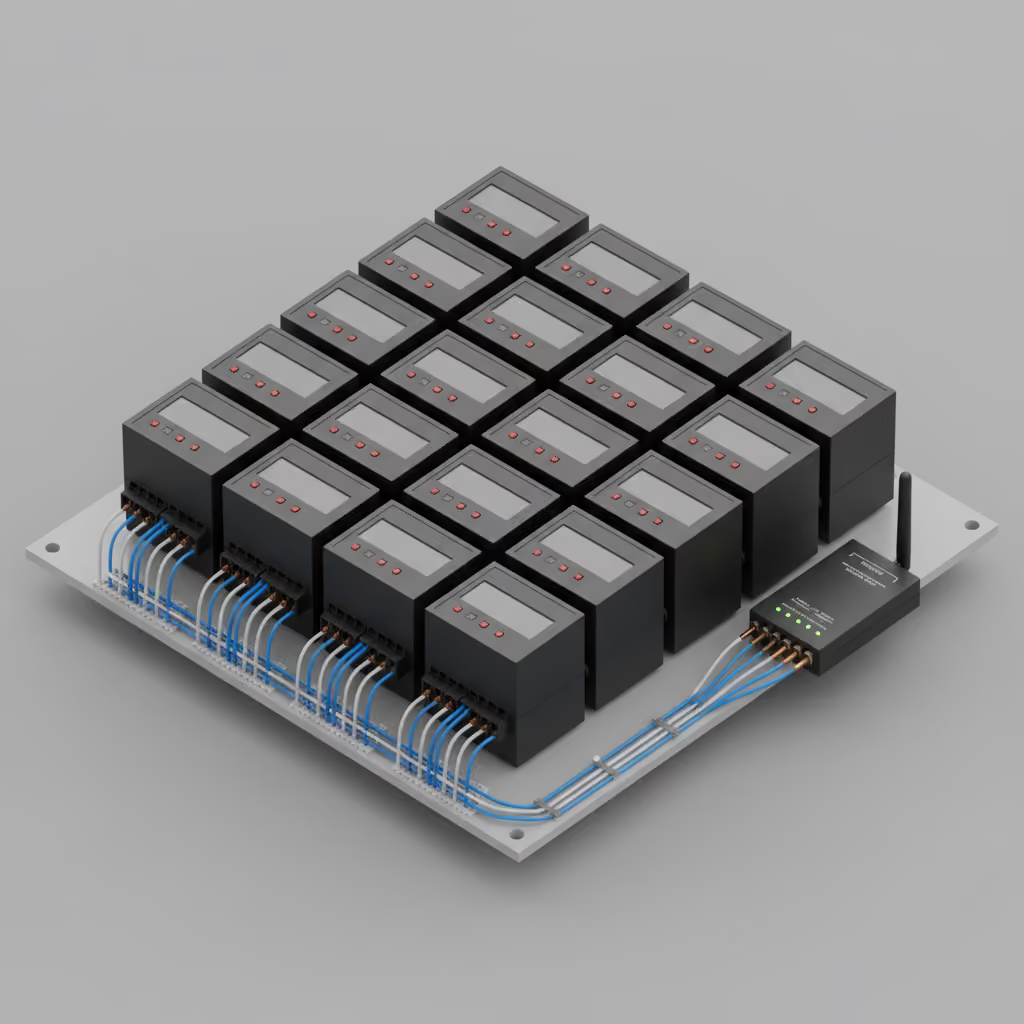
Challenge
A commercial shopping mall operates 12+ hours daily with diverse tenants (retail, F&B, cinema) with varying operational schedules and energy demands. The challenge: optimize energy efficiency while maintaining tenant comfort and customer experience across different building zones.
Solution
EcoXplore deployed an integrated building management and energy optimization system with:
- Smart metering for common areas and individual tenant sub-meters
- Zone-based HVAC control responsive to occupancy and tenant operational schedules
- Automated lighting control using occupancy sensors and daylight harvesting
- Predictive maintenance for critical building systems including chillers and air handling units
Results
- Reduced common area energy consumption by 21% through automated controls and scheduling
- Improved mall atmosphere and tenant satisfaction through responsive environmental controls
- Prevented 4 critical HVAC failures through predictive monitoring
- Achieved energy cost savings of USD 240,000 annually
.avif)
Challenge
A major transportation hub (airport or railway station) operates 24/7 with complex systems including baggage handling, security, passenger facilities, and operations centres. The challenge: maintain critical system reliability while optimizing energy costs in a facility with significant daily load variations.
Solution
EcoXplore deployed an integrated facility and energy management solution with:
- Real-time monitoring of all critical systems including power, HVAC, baggage systems, and security
- Predictive maintenance for baggage handling equipment, security systems, and HVAC
- Dynamic load scheduling to shift non-critical loads to off-peak hours when energy rates are lower
- Advanced anomaly detection to identify equipment issues before they impact passenger experience
Results
- Achieved 99.95% uptime for critical systems, ensuring reliable passenger operations
- Reduced energy costs by 14% through dynamic load scheduling
- Prevented 12 equipment failures that would have disrupted passenger operations
- Improved operational efficiency and customer satisfaction through reliable facility operations

Challenge
A large correctional facility required a comprehensive building automation system (BAS) to manage security, access control, HVAC, lighting, and emergency systems across 50+ buildings. The challenge: integrate disparate legacy systems into a unified platform, and ensure 24/7 reliability with automated response to anomalies.
Solution
EcoXplore deployed a modern BAS that:
- Unified access control, HVAC, lighting, and emergency systems under a single platform
- Provided automated schedules for heating, cooling, and lighting based on occupancy patterns
- Integrated alarms and alerts from all systems into a centralised command centre
- Enabled predictive maintenance of critical systems like backup generators
Results
- Reduced energy consumption by 22% through automated scheduling and predictive maintenance
- Achieved 99.9% system uptime with automated failover and alerting
- Enabled staff to respond to facility issues within minutes rather than hours
.avif)
Challenge
A multinational semiconductor manufacturer required advanced Power Quality Monitoring across a 15MW manufacturing facility. The challenge: manufacturing processes are extremely sensitive to voltage sags, harmonics, and transients, all of which disrupt production and compromise product quality. Traditional power quality monitoring is performed via periodic assessments; ongoing visibility is critical.
Solution
EcoXplore implemented continuous power quality monitoring with:
- Real-time measurement of voltage, current, frequency, harmonics, and transient events across the distribution network
- AI-driven detection of PQ events with automatic root cause analysis (e.g. utility supply vs. internal loads)
- Correlation of power quality events with production disruptions to quantify business impact
Results
- Identified 3 major sources of harmonic distortion that were degrading production yield
- Achieved 99.7% uptime through PQ-driven predictive maintenance
- Reduced production rejects by 2.3% through better PQ management
- Established baseline PQ metrics to support vendor negotiations and utility rebate programs
.avif)
Challenge
Singapore's National Museum operates a sophisticated climate control system required to protect invaluable artefacts while maintaining public comfort. The challenge: maintain precise temperature and humidity control across 15+ gallery spaces with minimal manual oversight, and automatically respond to any deviation that could damage collections.
Solution
EcoXplore deployed a building management system with:
- Continuous environmental monitoring across all gallery spaces and storage areas
- Scheduled maintenance of HVAC systems based on equipment condition and energy efficiency, not just calendar dates
- Real-time alerts for out-of-specification environmental conditions, triggering immediate corrective action
Results
- Zero instances of environmental deviation exceeding museum preservation standards
- Reduced HVAC energy consumption by 18% through predictive maintenance and optimised scheduling
- Automated 95% of environmental monitoring tasks, freeing staff for artefact care

Challenge
A university campus spans 100+ hectares with 50+ buildings including academic facilities, dormitories, research laboratories, and sports facilities. The challenge: optimize energy and resource consumption while maintaining diverse comfort and operational requirements across disparate building types.
Solution
EcoXplore deployed a comprehensive campus-wide facility management platform with:
- Smart metering on all major buildings and utility points
- Central monitoring and control of building systems from a command centre
- Automated schedules for HVAC, lighting, and other systems based on building occupancy and function
- Integration with campus IT systems to correlate building operations with academic calendar
Results
- Reduced campus-wide energy consumption by 20% through optimized controls and scheduling
- Improved student and staff satisfaction through responsive environmental controls
- Detected and prevented 5 equipment failures through predictive monitoring
- Achieved sustainability goals supporting campus carbon neutrality commitments
.avif)
Challenge
A commercial district with 30+ office and retail buildings consumes significant electricity. The challenge: reduce district-wide energy consumption and carbon footprint while maintaining tenant satisfaction and building asset value.
Solution
EcoXplore deployed an integrated district energy management platform with:
- Smart metering across all buildings in the district
- Centralised visibility of consumption patterns across all buildings
- Cross-building demand response coordination to optimize peak load management
- Benchmarking of building performance against industry standards and peers
Results
- Reduced district-wide energy consumption by 18% through optimized operations and demand response
- Improved energy efficiency ratings for 20+ buildings, supporting tenant retention and premium rents
- Enabled participation in utility rebate programs, recovering USD 150,000 in incentives
- Positioned district as a leader in sustainable building operations, improving marketing appeal

EcoXplore provides preventive and corrective maintenance services for the power monitoring system at the Supreme Court of Singapore. The maintenance contract ensures continuous, reliable operation of the monitoring infrastructure at this critical government facility.
Learn about our maintenance services or contact us for government facility support.
.avif)
EcoXplore installed a programmable Omron PLC for conveyor belt systems at Changi Airport. Our company also supplied, delivered, commissioned, tested, and installed a power monitoring system to track electrical consumption across airport infrastructure.
Learn more about our engineering and integration services or contact us for critical infrastructure projects.
.avif)
EcoXplore provides maintenance of information, communication, and technology devices for PCF Community Foundation LCCC at Marsiling Mega 2. The scope includes building management and monitoring systems maintenance conducted on a half-yearly basis.
Explore our maintenance and support services or contact us.
.avif)
EcoXplore supplied, delivered, and installed the Power Monitoring System and devices at the LT Switch Room and Air Conditioning Switch Room (with meter kiosk) as part of the BMS replacement project at the URA Centre. The system provides centralised visibility into the building's power distribution.
Contact our team to discuss power monitoring for government buildings.

EcoXplore carried out extension works for the real-time metering system at Power Seraya, one of Singapore's major power generation companies. The project expanded the facility's monitoring capabilities with additional metering points and system integration.
Learn about our engineering services or contact our team.
.avif)
Pioneer Insurance in the Philippines utilises EcoXplore's Energy Management System (EMS), which includes the supply, installation, testing, and commissioning of engineering and programming works, communication setup, and system configuration. This project demonstrates EcoXplore's regional delivery capability across Southeast Asia.
Contact us to discuss cross-border energy monitoring projects.

Challenge
A leading telecomunications operator needed comprehensive DCIM visibility across two major data centre facilities. The challenge: correlated monitoring of IT equipment (servers, switches, storage), infrastructure systems (power, cooling), and environmental conditions, with the ability to predict resource exhaustion before it impacts service delivery.
Solution
EcoXplore implemented a complete DCIM solution with:
- Continuous monitoring of PDU power delivery, UPS status, and server inlet temperatures
- Visualisation of rack-level power and cooling density to identify hot spots and underutilised capacity
- Predictive capacity planning through 90-day forecasting of power and cooling demand
- Integration with existing IT management tools via API to correlate infrastructure health with application performance
Results
- Reduced cooling energy consumption by 12% through optimised airflow management
- Prevented 2 potential UPS failures through predictive monitoring
- Improved PUE (Power Usage Effectiveness) from 2.1 to 1.7, bringing the facility closer to industry best practice (1.5)
- Enabled confident capacity planning for new server deployments
.avif)
Challenge
A major media conglomerate required real-time monitoring of 1,000+ energy meters deployed across multiple broadcast facilities, data centres, and production studios. The challenge was twofold: (1) aggregate consumption data from dispersed locations into a unified view, and (2) identify energy efficiency opportunities within the complex energy infrastructure that spans facility power, backup generators, UPS systems, and specialised broadcast equipment loads.
Solution
EcoXplore deployed a scalable Energy Management System (EMS) architecture with:
- 1,000+ smart meters deployed across all facilities, using ZETA LPWAN to transmit consumption data every 15 minutes
- IoT OSS Platform as the central aggregation and analysis engine
- Real-time dashboards showing facility-level and system-level consumption patterns
- AI-driven anomaly detection to identify sudden consumption spikes that could indicate equipment faults or inefficient operation
Results
- Consolidated visibility of energy consumption across 1,000+ meters in real time
- Identified a 15% overall energy consumption baseline
- Detected anomalous patterns in backup generator run cycles, leading to maintenance optimisation
- Achieved 8% month-on-month energy reduction through operational adjustments


IoT Products
35
02
02
02
02
02
02
02
02
02
02
02
02

Dempsey Hill @ Tanglin
ZETA System – Monitoring of sensors, access points (AP), and motes located across multiple locations.

Resort World Sentosa
Environment Management System: Monitoring temperature, humidity, and water leakage using ZETA IoT products.

Parkway Parade
Power Monitoring System: This PMS project involves the supply of power meters and the testing of all rated accessories to ensure full system functionality.

Canberra Community Club
The Energy Management System (EMS) enables monitoring of both power meters and water meters.

Nursing Home Venus Drive
Building Management System: This BMS project involved the supply of water meters and the testing of all rated accessories to ensure full system functionality.
.avif)
VISA
Monitoring of AI and DI devices with a well-developed graphical user interface (GUI), including alarm management via SMS notifications.

Mediacorp Pte Ltd.
Long-term PMCS partner for MediaCorp's broadcast campus. EcoXplore deployed and maintains a comprehensive Power Monitoring and Control System covering 1,000+ panel meters, 130 data loggers, and 30 server instances running PecStar iEMS.
.avif)
Singtel Data Centre
Full data centre fit-out for SingTel DC West, Level 6, Hall 11. Scope included supply, installation, software configuration, testing, and commissioning of the complete Environmental Monitoring and Reporting System (EMRS), including space sensors and dew point monitoring.
.avif)
National Museum of Singapore
Scheduled maintenance services for the Building Management System (BMS) at the National Museum of Singapore, ensuring reliable climate control and facility operations for one of Singapore's most significant heritage buildings.

Abbott Manufacturing Singapore
The aim of the project was to interface energy meters to existing Building...

Mead Johnson Nutrition
The aim of the project was to integrate with the WAGES system for centralized utility monitoring.
.avif)
Infineon Technologies
EcoXplore assisted with engineering works, software configuration, and programming. Furthermore, they provided continued support throughout the project implementation.

Global Foundries
Installation of a Power Quality Meter system at GlobalFoundries' F3E semiconductor fabrication facility in Singapore, providing real-time power quality analytics for one of the world's most demanding manufacturing environments.
.avif)
Systems of Silicon Manufacturing
The aim of the project was to supply, deliver, install, test, and commission a Power Quality System for the client’s electrical systems.

Sentosa Development Corporation
EcoXplore carried out engineering and programming work for Sentosa without disrupting ongoing operations.

Singapore Prison Service
Comprehensive maintenance of the Building Automation System (BAS) for the Singapore Prison Service, covering multiple correctional facilities under a multi-year contract with the Ministry of Home Affairs.
.avif)
Housing and Development Board
The aim of the project was to install an electrical sub-metering system for enhanced energy monitoring and management.

Public Utilities Board (PUB)
The aim of the project was to supply and install a gateway for the Power Monitoring System at Changi Water Reclamation Plant.
.avif)
Singapore General Hospital
EcoXplore supplied, installed, and configured the Power Monitoring Device.
Ng Teng Fong General Hospital
Ng Teng Fong General Hospital
.avif)
KK Women's and Children's Hospital
The aim of the project was to supply, install, and configure a Power Monitoring System to enhance energy oversight and efficiency.

Alexandra Hospital
Located in Queenstown, Singapore, Alexandra was formerly known as the British Military Hospital and served as the main medical facility for British forces in the region.
.avif)
GlobalFoundries
EcoXplore supplied, delivered, installed, tested, and commissioned the Power Quality Management System (PQMS).
.avif)
James Cook University
Opened in 2003, JCU Singapore is the Singapore campus of James Cook University, headquartered in Townsville, Australia.

MOL (Asia Oceania) Pte Ltd
This project involved the installation of an Energy Management System at the MOL office in the UIC Building.
.avif)
Raffles City Shopping Centre
Provision of data logging, as well as monitoring and engineering services.

National Museum
Provision of preventive and corrective maintenance services for the power monitoring system at the Supreme Court building, for a period of one year.
.avif)
SingTel DC West
EcoXplore installed a programmable Omron PLC to control conveyor belt systems.
.avif)
SingTel DC West
Provision of data logging, monitoring, and engineering services.
.avif)
The URA Centre
EcoXplore supplied, delivered, and installed the Power Monitoring System and devices at the LT Switch Room and Air Conditioning area.

Power Seraya
The aim of the project was to carry out extension works for the real-time metering system.
.avif)
Pioneer Insurance (Philippines)
Provision of data logging, along with monitoring and engineering services.

RF360
Power Quality Management System: Supply and install power meters and software to monitor and record power quality parameters.
.avif)
WNC
Energy Monitoring System: Supply and install power meters and software to monitor the power supply.
Lebih Banyak Tentang Ecoxplore
Kami berdedikasi untuk memberdayakan bisnis dengan perangkat lunak dan layanan yang mendorong efisiensi dan pertumbuhan
Lihat lebih banyak

.svg)

.svg)

.svg)
.svg)
