


.svg)







EMS vs BMS vs DCIM: Which System Does Your Singapore Facility Actually Need?
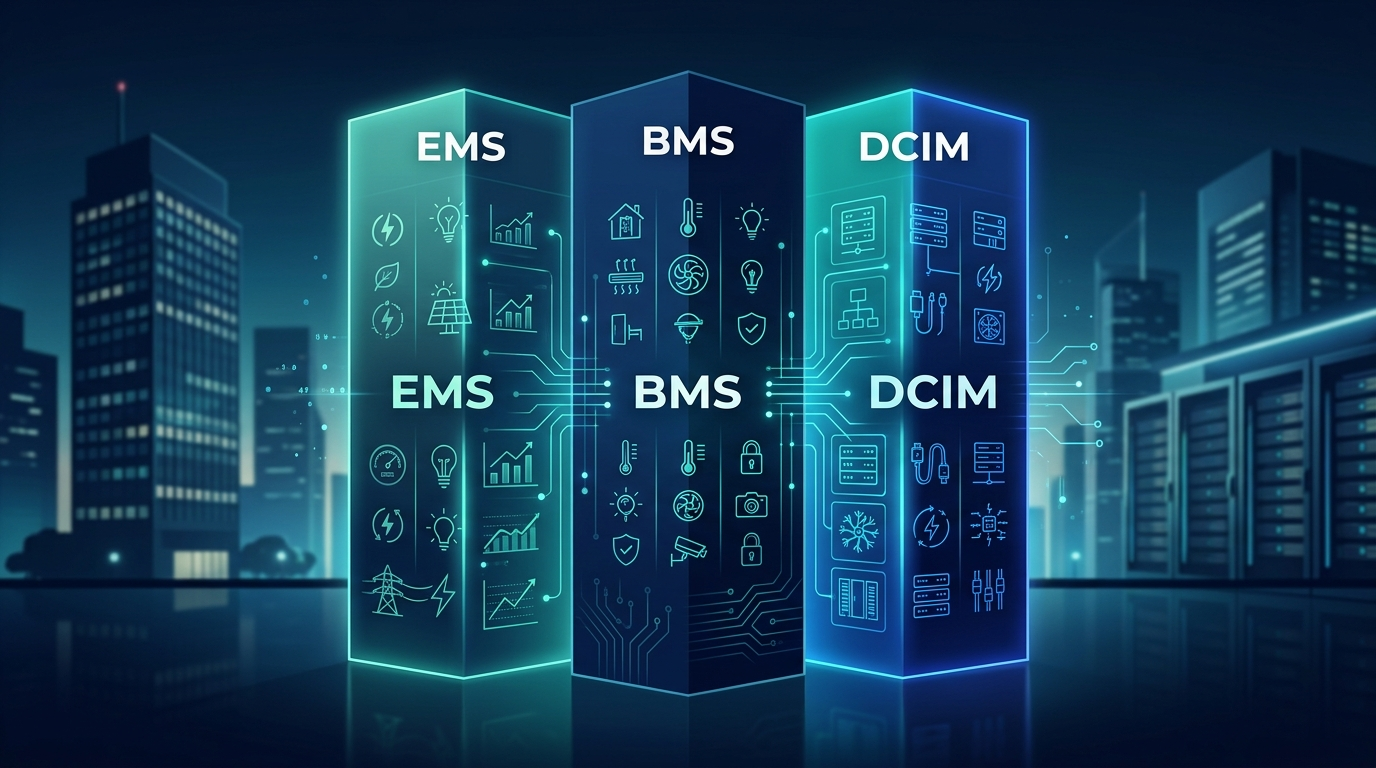
The Three Systems at a Glance
| System | What It Manages | Primary Users | Typical Deployment |
|---|---|---|---|
| BMS (Building Management System) | HVAC, lighting, access control, fire safety, lifts | Facility operations team | Commercial buildings, hospitals, malls, airports |
| EMS (Energy Management System) | Electricity, water, gas, steam consumption and cost | Sustainability leads, energy managers, finance | Any facility with significant utility spend |
| DCIM (Data Centre Infrastructure Mgmt) | Power chains, cooling, rack capacity, PUE, assets | Data centre operations team | Data centres, server rooms, colocation facilities |
The overlap is real. A BMS controls the chiller plant; an energy management system monitors the chiller's energy consumption and calculates cost per kilowatt-hour; a DCIM tracks how that cooling capacity maps to specific server racks. All three might read the same power meter, but each asks a different question of the data.
BMS: The Building's Nervous System
A Building Management System is the operational backbone of any large commercial facility. It connects to controllers, actuators, and sensors across HVAC, lighting, fire safety, and security systems, providing centralised monitoring and automated control. When an office floor reaches 24 degrees Celsius, the BMS tells the air handling unit to increase cooling. When motion sensors report an empty zone after 7:00 PM, the BMS dims the lights.
In Singapore, BMS deployment is often driven by regulatory requirements. The Building and Construction Authority's Green Mark scheme awards points for advanced building management system capabilities, including chiller plant efficiency monitoring and fault detection. The Building Control Act requires periodic inspection of mechanical and electrical systems in existing buildings, and a well-maintained BMS generates the operational logs needed for compliance.
EcoXplore has deployed BMS solutions in heritage and institutional settings, including the National Museum of Singapore, where precision environmental control is critical for artefact preservation. The system monitors temperature, humidity, and air quality across multiple gallery zones, adjusting conditions in real time while logging data for curatorial review.
However, a BMS has a fundamental limitation: it controls equipment but typically does not analyse energy cost or carbon impact. It can tell you that Chiller 3 is running at 85 percent load; it cannot tell you that Chiller 3 costs SGD 340 per day to operate or that shifting its runtime by two hours would reduce your peak demand charge by 18 percent. That is where an EMS comes in.
EMS: The Financial and Carbon Lens
An energy management system sits one layer above the BMS. It collects consumption data from power meters, water meters, gas meters, and steam flow sensors - collectively called W.A.G.E.S. monitoring - and translates raw kilowatt-hours into cost, carbon emissions, and efficiency benchmarks.
This translation layer matters enormously in Singapore's current regulatory environment. The Carbon Pricing Act, with a carbon tax rate of SGD 45 per tonne of CO2 equivalent in 2026-2027, directly increases the cost of grid electricity. ACRA and SGX require climate-related disclosures aligned with ISSB standards, mandatory for listed companies from FY 2025 and extending to large non-listed companies by FY 2030. An EMS generates the auditable energy data needed for these submissions - a BMS alone cannot.
EcoXplore's PecStar® iEMS platform serves as the EMS layer, integrating data from over 1,000 panel meters at the MediaCorp PMCS deployment across 30 server rooms and multiple broadcast facilities. The platform tracks consumption trends, identifies anomalies, and generates automated reports aligned with ISO 50001 energy management standards and BCA Green Mark submission requirements.
Crucially, an EMS does not replace a BMS - it complements it. The BMS controls; the EMS analyses. A facility that installs only an EMS without a BMS gains visibility but no automated control. A facility with only a BMS can maintain comfort but cannot demonstrate energy performance to regulators, investors, or tenants.
DCIM: Precision for the Data Centre Floor
Data Centre Infrastructure Management addresses a niche that neither BMS nor EMS fully covers. In a data centre, the critical question is not "is the building comfortable?" but "can each rack receive the power and cooling it needs, and what is our Power Usage Effectiveness (PUE)?"
DCIM platforms map the entire power chain - from the utility feed through UPS, power distribution units, and down to individual rack-level power strips. They track cooling capacity allocation, environmental conditions at the hot and cold aisles, and asset lifecycles. They calculate stranded capacity (power or cooling that is installed but cannot be used because of distribution constraints) and forecast when a data hall will hit its limits.
In Singapore, DCIM has become effectively mandatory for operators participating in the Infocomm Media Development Authority's Data Centre Call for Application schemes, which require operators to demonstrate PUE targets of 1.3 or better. EcoXplore deployed data centre infrastructure management capabilities at SingTel DC West, monitoring power and environmental conditions to maintain operational efficiency across multiple data halls.
A DCIM is typically deployed alongside, not instead of, a BMS. The BMS manages the mechanical plant that serves the data centre; the DCIM manages the IT load that the plant serves. An EMS can complement both by tracking the energy cost and carbon footprint of data centre operations, feeding into corporate sustainability reporting.
How to Decide: A Decision Framework
Rather than choosing one system, most Singapore facilities need a layered approach. Here is a decision framework based on facility type:
Commercial office buildings: Start with a BMS for HVAC and lighting control. Add an EMS when energy costs exceed SGD 20,000 per month or when Green Mark certification or sustainability reporting becomes a requirement. The BMS provides the control; the EMS provides the business case and compliance evidence.
Manufacturing and industrial facilities: An energy monitoring system is often the higher priority, because energy and water can represent 15 to 40 percent of operational costs. Pair with condition monitoring for mission-critical production equipment. A BMS is needed only if the facility has significant HVAC-controlled space.
Data centres: DCIM is non-negotiable for capacity planning and PUE compliance. Layer an EMS for carbon reporting. A BMS is already present in most Tier III and Tier IV facilities for mechanical plant control.
Multi-building estates and campuses: Deploy a centralised EMS as the unifying analytics layer, with individual BMS instances per building feeding data upward. This architecture - which EcoXplore has implemented across multiple ASEAN markets - gives the sustainability team a single dashboard for energy and carbon reporting while keeping building-level automation independent.
One Platform, One Vendor, Less Integration Risk
A common pitfall is buying a BMS from one vendor, an EMS from another, and a DCIM from a third, then spending months - and significant integration engineering fees - making them talk to each other. Each integration point introduces latency, data format mismatches, and a single point of failure that no single vendor owns.
EcoXplore's approach is to deliver all three layers - BMS, EMS, and DCIM - from a single engineering team, with PecStar iEMS as the common software platform. Power meters, environmental sensors, and controllers from multiple manufacturers feed into one data backbone. Facility managers get one dashboard, one support contact, and one source of truth for energy, operations, and compliance reporting.
To discuss which combination of BMS, EMS, and DCIM fits your facility's specific requirements and regulatory obligations, contact EcoXplore's engineering team through our website. We provide site assessments, system architecture recommendations, and phased deployment plans across Singapore, Malaysia, Thailand, Indonesia, and Vietnam.


EMS vs BMS vs DCIM: Sistem Mana yang Sebenarnya Dibutuhkan Fasilitas Singapura Anda?
EMS vs BMS vs DCIM: Cơ Sở Tại Singapore Của Bạn Thực Sự Cần Hệ Thống Nào?
More About Ecoxplore
We are dedicated to empowering businesses with software and services that drive efficiency and growth
View more

.svg)

.svg)

.svg)
.svg)

More About Ecoxplore
We are dedicated to empowering businesses with software and services that drive efficiency and growth
View moreข้อมูลเพิ่มเติมเกี่ยวกับ Ecoxplore
เรามุ่งมั่นในการช่วยให้ธุรกิจของคุณทำงานได้อย่างมีประสิทธิภาพและเติบโตอย่างยั่งยืนด้วยซอฟต์แวร์และบริการของเรา
ดูเพิ่มเติมMore About Ecoxplore
We are dedicated to empowering businesses with software and services that drive efficiency and growth
View moreLebih Banyak Tentang Ecoxplore
Kami berdedikasi untuk memberdayakan bisnis dengan perangkat lunak dan layanan yang mendorong efisiensi dan pertumbuhan
Lihat lebih banyakMore About Ecoxplore
We are dedicated to empowering businesses with software and services that drive efficiency and growth
View moreLebih Banyak Tentang Ecoxplore
Kami berdedikasi untuk memberdayakan bisnis melalui perangkat lunak dan layanan yang mendorong efisiensi serta pertumbuhan.
Lihat selengkapnyaMore About Ecoxplore
We are dedicated to empowering businesses with software and services that drive efficiency and growth
View moreHiểu thêm về Ecoxplore
Chúng tôi cam kết trao quyền cho các doanh nghiệp bằng phần mềm và dịch vụ giúp tăng cường hiệu quả và phát triển
Xem thêm